Praiano
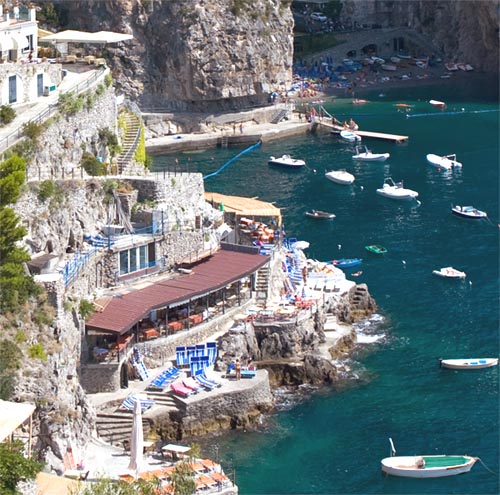
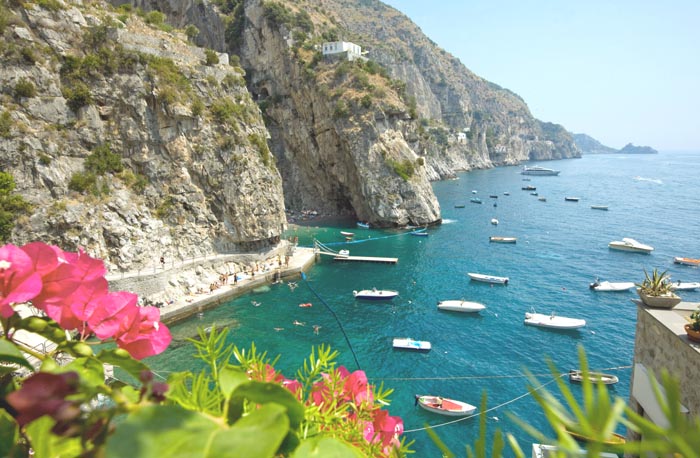
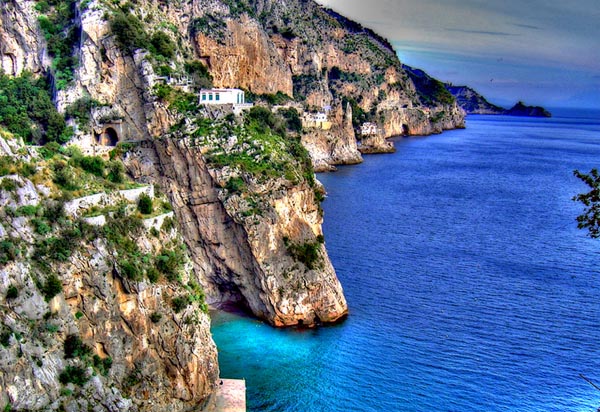
liegt wie ein eingefasster Diamant, in einer zauberhaften Lage, an der
schönsten Küste (auch göttliche Küste genannt), zwischen Positano (4 km) und
Amalfi (9 km). Altes, ehemaliges Fischerstädtchen…heute Klima- und Seebad
mit Prestige.
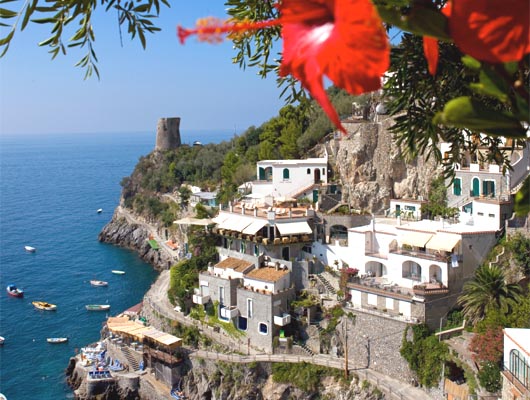
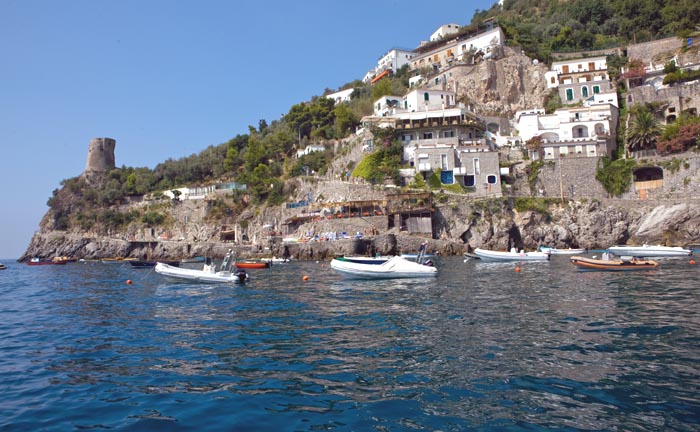
Praiano verfügt über eine sehr gute Beherbergungskapazität die man vom Meer
aus, am Hang, wie ein Fall weisser Häuser – der sich inmitten einer grünen,
blühenden Natur befinden, bewundern kann. Im Westen die Fraktion von Praiano
“Vettica Maggiore”, exklusives Badezentrum. Ein alter Spruch sagt: “Wer
gesund leben will…soll seine Zeit am Morgen, am Meer, in Vettica verbringen
und sich am Abend in Praiano vergnügen……. das beste Rezept für 24 Stunden”.
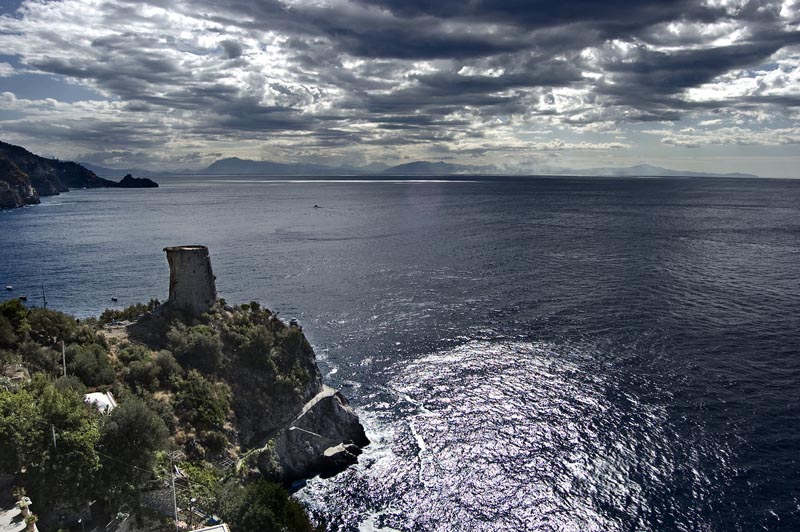
Die Küstentürme sind Symbole und Erinnerungen an die Vergangenheit und sind
sogleich die Charakteristiken des Touristenzentrums Praiano.
Praiano gehört zu den bekanntesten und beliebtesten Orten der “Amalfitana
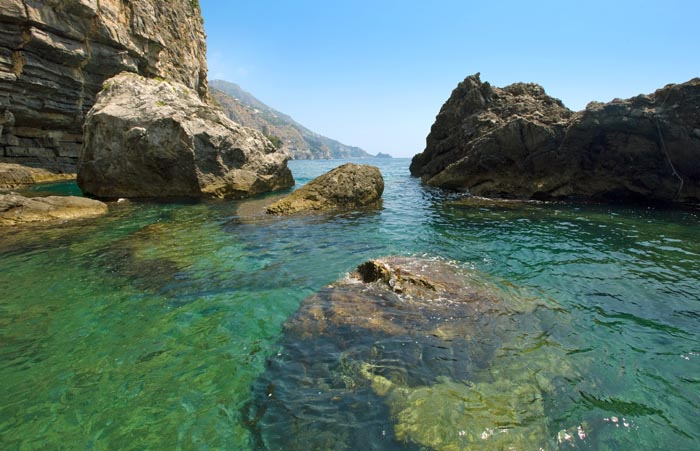
Küste”. An diesem Ort kann man u.a.noch eine unveränderte, unberührte Natur
bewundern und geniessen.

Praiano is set like a diamond in an
enchanting location, nestled among the beautiful inlets of the breathtaking
Amalfi coast, a mere seven kilometers from Positano and six kilometers from
Amalfi.
Once an ancient fishing village, today it is a prestigious
seaside resort.Praiano, known for its fine climate and excellent facilities,
presents itself to the sea as a cascade of white houses on a green,
flowering slope. To the west, the village of Vettica Maggiore
is a charming site for a seaside sojourn. An old local adage says "Chi
vuol vivere sano, la mane a Vettica, la sera a Praiano". The
prescription is clear: for a healthy life, morning hours must be
spent in Vettica and evenings in Praiano. Here you'll find the secrets of
local vitality and love of life.The coastal towers, dramatic symbols of
the past, are characteristic of Praiano, one of the most famous resorts of
the Amalfi coast. It is a favourite destination for visitors who love to
enjoy nature in all its original splendor.
Praiano,
originally known as Plagium or Pelagianum, was once the holiday resort of
the Amalfitan Doges. Today it may lack the splendour of Medieval nobility,
but it has maintained its timeless charm as a small fishing village
perched on the cliffs between its more famous neighbours, Positano and
Amalfi. For its defense a tower was built by Charles I of Anjou. Praiano’s
local economy was built upon two products, the first being the production
of silk, and its use by the local women in the manufacture of handmade
articles for clothing etc. In past centuries silk and thin, fine yarn was
turned white and worked by the women of the town, and the popularity of
this fabric helped the town flourish. The coral fishing industry was no
less lucrative, and the men collected coral from the sea and fashioned it
into beautiful jewelry, among other things.
Both
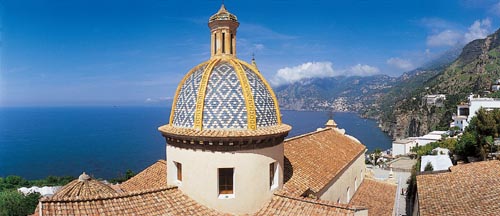
historically and architecturally, the most important building today in
Praiano is the Church of Saint Luke the Evangelist, which also holds this
saint's remains. The Church boasts fine paintings by Giovanni Bernardo
Lama (including the Madonna with Child) and a silver bust of the saint,
dated 1694.
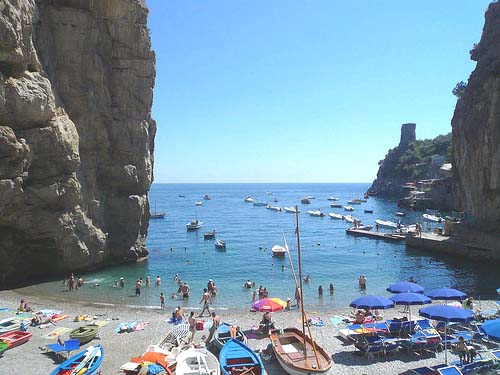
Today Praiano is a prestigious sunning, swimming and boating destination,
offering tourists from all over the world a tranquil location from which to sample the
joys of the coastline, with convenient proximity to the tourist towns of Positano, Amalfi,
and Ravello.
 |
|
Environment resources - What
to see
St.MARIA DEL CASTRO CHURCH AND CONVENT
These were built by Dominican Fathers in 1599; the convent was suppressed
at the end of XVIIth cen. It has been recently restored together with the church thanks to
the monks stong work.
St.LUCA EVANGELISTA CHURCH
Saint Lucas remains are kept here, a silver bust of him from 1694
and canvases attributed to 16th century painter Giovanni Bernardo Lama. Madonna
del Rosario by Padovano di Montorio, dated 1572, is situated in a chapel on the right of
altar. The interior of the church, restored in 1772, has three naves divided by pillars
supporting beautiful rounded archs.
Also very interesting are: a wood pulpit with paintings representing St. Pietro and St.
Paolo, major altar in '1700 majolica and the floor with birds, flowers and St. Luca are
painted. To the right of the church is the three story belfry and the "monofore.
|
|
GRADO A VETTICA DI PRAIANO COAST TOWER
This ancient Viceroyal tower visible from Positano was built to guard
against sea invaders, and has recently been transformed into a private house.
SCIOLA COAST TOWER
Another coastal tower, this one built in the Angevin age on a circular
plant and transformed during Spanish reign, using the base part of medieval building. This
tower is seen at the left of the hotel in several photos on our website and is a very
short walk from the hotel.
The wooded territory of the town of
Praiano extends for about 30 hectares; the largest is named "il Campo" (the
Field), and extends up the Fontanelle valley, where St. Domenico church and convent are
sited; it is possible to reach it by a recently restored flight of steps. |
|
Praiano does not lie directly on the coast, but parallel to the sea,
and for a long stretch, upwards and downwards of the state road. Scattered houses which at
intervals gather and spread over the countryside. Now and then a "scalinatella"
(a flight of little steps) winds up among the houses and then goes downwards to the high
and impassable coast, among the lemon terraces and through the Mediterranean blooming
bush. Here and there, a little creek, a little beach, a Paradise corner, as for example
the seashore of Praia, the only real landing-place of this steep coastal stretch.
Praiano
is a farmers' village with a great past: it was the seat of an Angioin University, the
summer residence of the Amalfi doges and even the production place of precious cloths.
That is why it economically prospered and developed even though not completely, because of
the prevalence of Amalfi in its neighbourhood. Not unlike the other coastal villages,
then, Praiano shared the decline of the powerful Sea Republic till it knew the bitter
poverty of the last centuries and of the beginning of the 20th century. Then,
tourism, at first the tourism of great travellers, then the tourism of common Italian and
foreign travellers, developed.
The Night Club "L'Africana",
which can be approached by a path excavated in the rock dropping to the sea, was the seat
of a cultural meeting-place in the Fifties and in the Sixties. The memory of the merry
nights of dancers and singers, of the short-lived and passionate loves of actresses and
latin lovers is still alive....
|